When the world talks about Spanish wine, Rioja and Ribera del Duero are often mentioned. But there is one region that does not announce its arrival but comes quietly, powerfully and for good – Priorat. And beside it, its younger, softer but no less substantial sibling – Montsant.
These two Catalan regions are more than marks on a wine map. They are a reflection of history, landscape and dedication, which has shaped wines that do not follow trends but forge their own path.
Geography and landscape: wine from the mountains
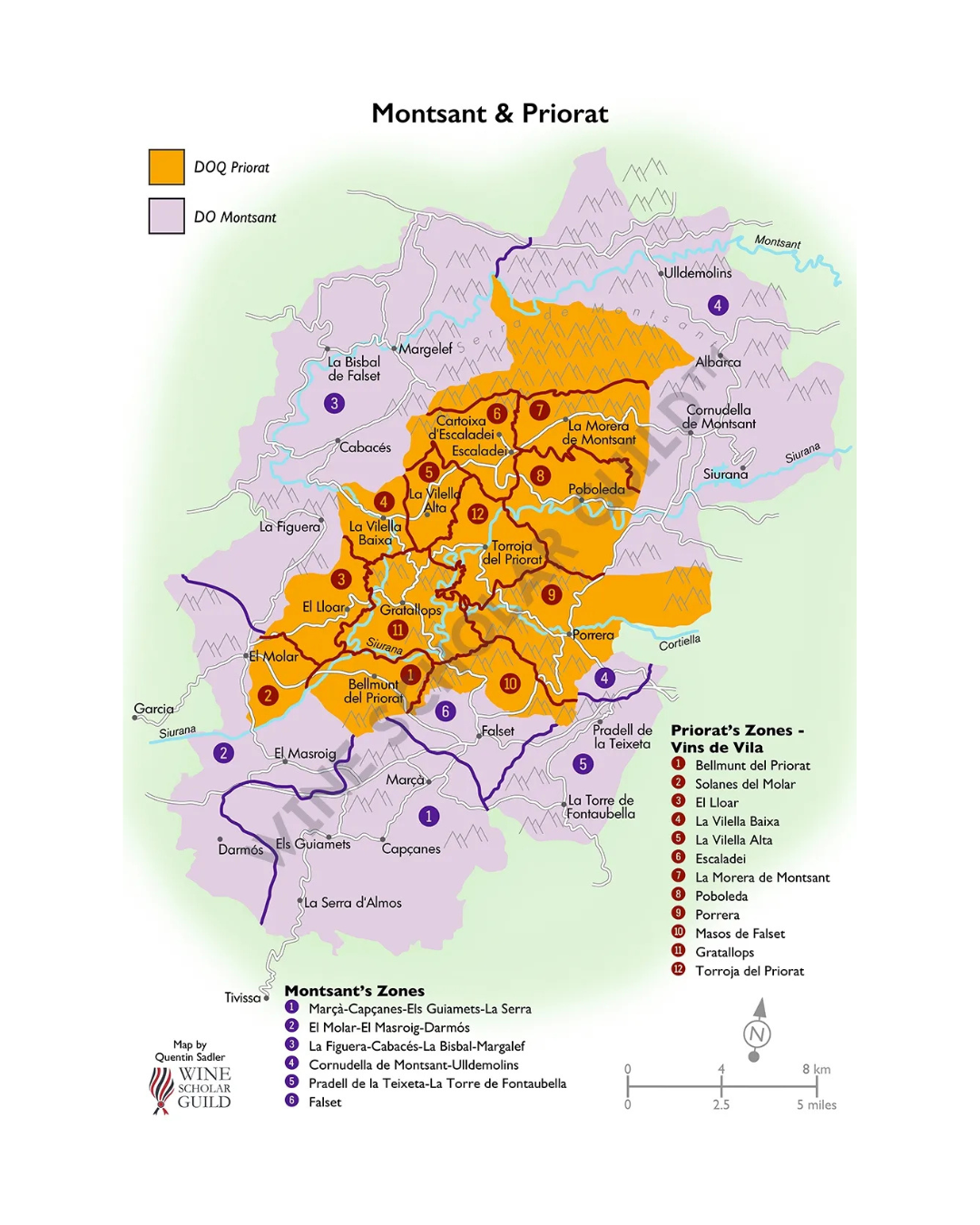
Priorat lies in the south of Catalonia, about 130 km from Barcelona. It is a mountainous region where the vines grow on steep terraces, right llicorella , i.e. on slate soil. Slate absorbs heat during the day and releases it at night, helping the grapes achieve full ripeness while retaining freshness.
Montsant (in translation "holy mountain") surrounds Priorat like a horseshoe. Although it is officially a separate DO (Denominación de Origen), it shares much of the same landscape, microclimate and grapes. The difference lies mostly in altitude, soil diversity and the overall style of the wine – Montsant tends to be a little softer, more approachable and easier to drink young.
History: monks, silence and rebellion
Viticulture in Priorat began as early as in the 12th century, when the Carthusians of Scala Dei founded a monastery and brought vines here. For centuries Priorat was a quiet wine district whose wines were rough and simple, intended for local consumption.
By the mid-20th century the region had become a backwater. Vineyards were abandoned and young people left for the cities. Then, in the 1980s, came five daring winemakers – among them René Barbier (Clos Mogador), Daphne Glorian (Clos Erasmus, later with the new name Clos i Terrasses), Álvaro Palacios (L’Ermita), Carles Pastrana (Clos de l’Obac) and Josep Lluis Pérez (Clos Martinet).
They bought back forgotten vineyards and laid the foundations for what is known today "the Priorat renaissance". The names of these wines began with the word "Clos", and they quickly became cult wines around the world.
Soil: slate that gives flavour
Llicorella is Priorat’s DNA. This blackish slate, which breaks down into thin layers, gives the wines:
In addition to llicorella, Montsant also has limestone, sandstone and clay soils, which make its wines softer and slightly “rounder” in character.
Climate: scorching sun and cool nights
The region is hot and dry, on the border between Mediterranean and continental climates.
Summer days can reach above 40°C,
but the nights are cool, preserving freshness in the grapes.
Rainfall is rare, which means that to survive the vines must to drive their roots deep – and this is what gives the wine its depth.
Grapes: old varieties, new expressions
Red varieties:
Garnacha (Garnatxa) – juicy, warm, berry-fruited
Cariñena (Carinyena) – fresh, tannic, deep
Syrah, Cabernet Sauvignon, Merlot – add structure and depth
White varieties:
Garnacha Blanca, Macabeu, Pedro Ximénez, Xarel·lo – help create full-bodied, mineral white wines, superb companions at the table
Style: wines with a voice and a soul
Priorat wines is traditionally known as:
Full-bodied and concentrated
With a firm tannic structure
With long ageing potential
But new-generation producers such as Dominik Huber (Terroir al Límit), bring a new approach into play: elegance, lower alcohol, minimal intervention.
Montsant is at the same time less extreme, often fruitier and softer, yet without lacking the depth of terroir.
Why does all this matter?
The wines of Priorat and Montsant are often not wines to be drunk in a hurry. They are not meant as a simple glassful. They are conversation partners, mirrors and sometimes also teachers.
diWine doesn't bring Priorat to Estonia because it's fashionable. We bring these wines because they speak to us. Because they are not just flavours – they are stories, terroir, generations and voices.
If you want a wine that doesn’t leave you unmoved – one that draws you deeper – then Priorat and Montsant are exactly the place to look.